Skip to content
dc.
Back to selected work

Open-source project

Laravel A/B Testing and TypeScript Integration

Typed Laravel experimentation primitives with a TypeScript companion for consistent client hydration.

LaravelTypeScriptReact & Vue

2 min read

At a glance

Organization
Independent open source
My role
Project author
Period
Open-source engineering
shared by the server and browser
One assignment

Project capabilities are documented in the linked public repositories. Production adoption is not implied.

One source of truth
user:42 → variant:control
Server HTML
Browser state

Illustrative assignment flow

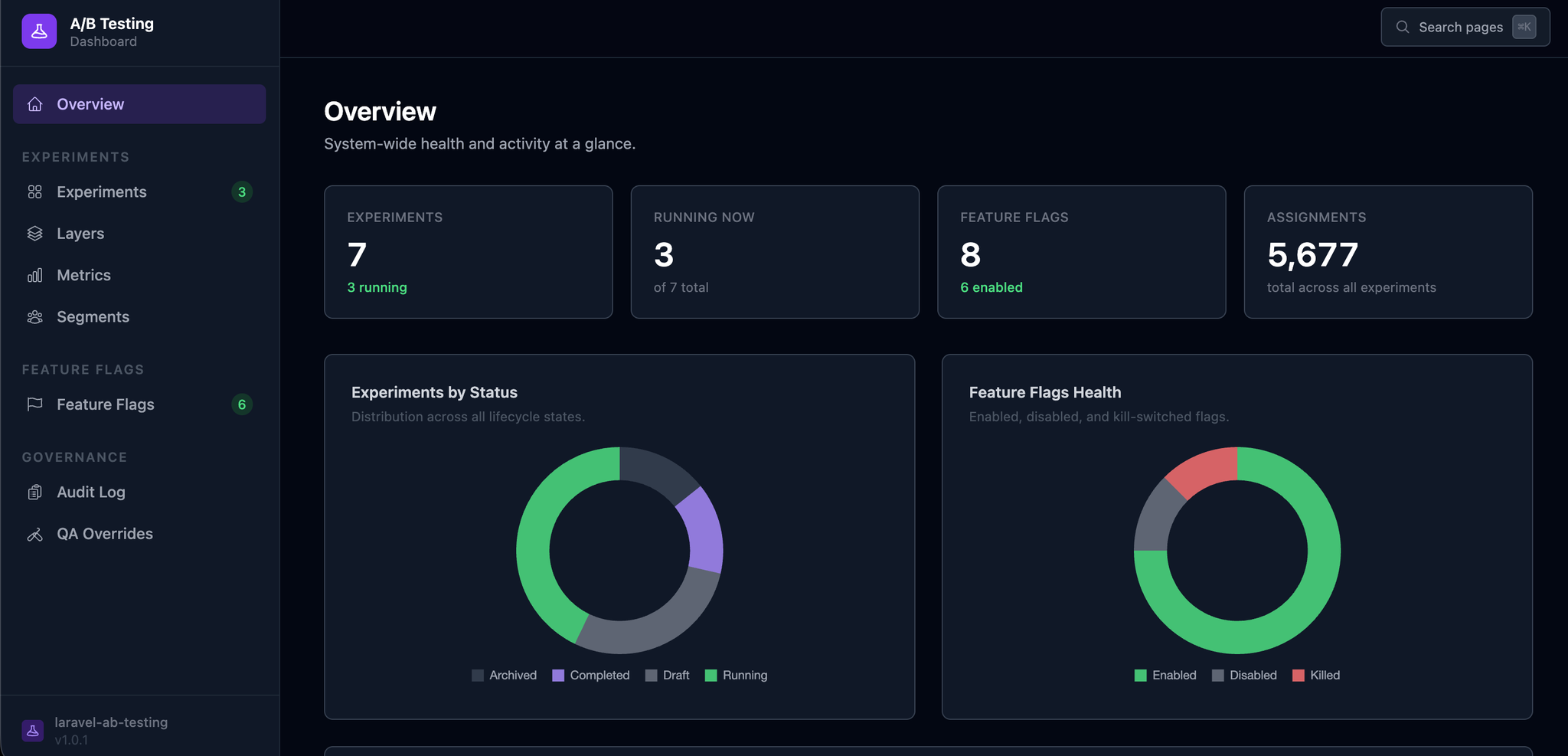
Laravel A/B Testing dashboard with experiment and feature flag summaries
Dashboard screenshot published in the project repository. The displayed values illustrate the interface; they are not evidence of production adoption. Inspect source
Laravel A/B Testing dashboard with experiment and feature flag summaries

Dashboard screenshot published in the project repository. The displayed values illustrate the interface; they are not evidence of production adoption.

The problem

An experiment needs more than randomly choosing a UI variant. Assignment should remain consistent, exposure should be distinguished from assignment, and the browser should display the variant the server selected.

This ecosystem separates backend experiment resolution from client-side consumption.

The Laravel engine

The Laravel package documents typed experiment definitions, deterministic bucketing, sticky assignment persistence, exposure and metric recording, and Bayesian and frequentist analysis. Its dashboard supports inspecting experiments and results.

The repository also describes current limitations. Runtime-defined authoring and parts of the feature-flag platform are not presented as complete.

The browser companion

The TypeScript SDK consumes assignments the server has already resolved. It reads an SSR meta payload or an assignments API and normalizes those values into a shared client.

Optional React and Vue integrations build on that client. The SDK is not a standalone bucketing engine and does not independently track exposures or metrics.

The central decision

The server owns the assignment. Reusing it in the browser avoids a second bucketing decision and helps prevent mismatches between rendered HTML and client state.

The SDK’s layered architecture separates domain contracts, application orchestration, transport adapters, and framework integrations. That keeps browser transport concerns away from the public assignment contract.

Evidence and scope

Both repositories document their integration contracts and usage. The visual on this page is a conceptual assignment flow, not live experiment data or a statistical result.

05 Let’s connect

Good work starts
with a conversation.

Have a challenging engineering problem, a role in mind, or an idea worth exploring? I’d like to hear about it.

derian.cordoba@icloud.com

Based in Nicaragua · Working with international teams

Let’s talk

Send a short introduction

Have a role, a collaboration, or a technical challenge in mind? Share a little context to start the conversation.

Opportunities · Collaboration · Engineering

Prefer to write directly?

derian.cordoba@icloud.com

All fields are required.

Your name, email, and message are processed by Netlify Forms to deliver your inquiry. Please avoid confidential information.